
As electricity prices continue to rise, more homeowners and businesses are switching to solar energy. Solar power is one of the cleanest and most reliable renewable energy sources available today. But many people still wonder: How does solar energy actually work?
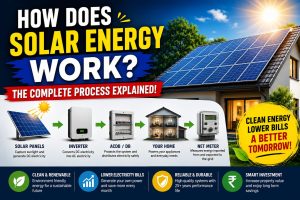
In this guide, we’ll explain the complete process in simple language.
Solar energy is the power we receive from the sun in the form of sunlight. Using modern solar technology, this sunlight can be converted into electricity that powers homes, offices, factories, farms, and commercial buildings.
Unlike fossil fuels, solar energy is renewable, environmentally friendly, and available every day.
Solar panels are made up of multiple photovoltaic (PV) cells. These cells contain semiconductor materials, usually silicon.
When sunlight strikes these cells, photons from the sunlight transfer energy to electrons inside the silicon. This movement of electrons creates Direct Current (DC) electricity.
However, most electrical appliances require Alternating Current (AC), which is why another component is necessary.
A solar inverter is often called the “brain” of a solar power system.
Its primary functions include:
– Converting DC electricity into AC electricity
– Monitoring the performance of the solar system
– Ensuring safe operation
– Optimizing energy production
Once converted into AC power, electricity can be used immediately by your home or business.
If your solar panels produce more electricity than you are using, the extra power can be:
– Exported to the utility grid through net metering (where available)
– Stored in solar batteries for later use
– Used to power additional electrical loads
This helps maximize the value of your solar investment.
A complete solar installation generally includes:
1. Solar Panels
Capture sunlight and generate DC electricity.
2. Solar Inverter
Converts DC power into usable AC electricity.
3. Mounting Structure
Secures the solar panels on rooftops or the ground at the correct angle.
4. ACDB & DCDB
Provide electrical protection for both AC and DC circuits, improving system safety.
5. Cables and Connectors
Transfer electricity efficiently between all components.
6. Net Meter (for Grid-Connected Systems)
Measures electricity imported from and exported to the utility grid.
Connected to the electricity grid. It is ideal for reducing electricity bills and works best in areas with a reliable power supply.
Operates independently of the utility grid and stores energy in batteries, making it suitable for remote locations.
Combines grid connectivity with battery storage, providing backup power during outages while maximizing solar usage.
Installing a solar power system offers several advantages:
– Lower monthly electricity bills
– Reduced carbon emissions
– Low maintenance requirements
– Long system lifespan (typically 25 years or more)
– Increased property value
– Energy independence
– Protection against rising electricity prices
For most residential and commercial users, the answer is yes.
Although there is an initial installation cost, the savings on electricity bills often recover the investment over time. With proper maintenance, solar systems continue generating clean electricity for decades.
– Install panels where they receive maximum sunlight.
– Clean the panels regularly to remove dust and debris.
– Use high-quality components from trusted manufacturers.
– Schedule periodic inspections to maintain system efficiency.
– Monitor system performance using inverter monitoring tools.
Solar energy is transforming the way we produce and consume electricity. By converting sunlight into usable electrical power, solar systems provide a sustainable, cost-effective, and environmentally responsible solution for homes and businesses.
Whether you’re planning a residential rooftop installation or a large commercial project, understanding how solar energy works is the first step toward making an informed investment in clean energy.